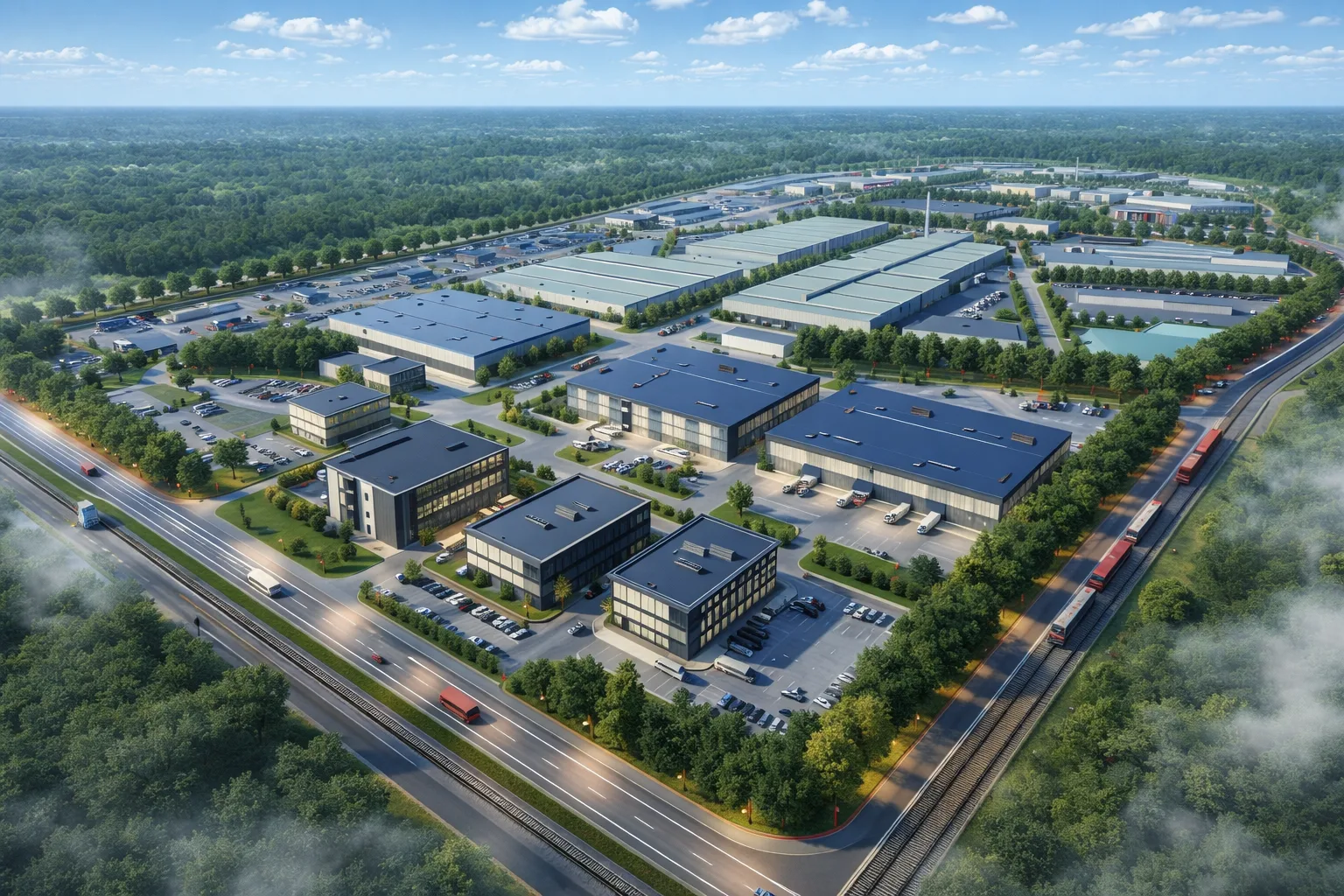
Build your next production site at the EU border — with lower entry costs than comparable sites in the EU
A greenfield industrial park location in Western Ukraine for European manufacturers seeking lower entry costs, competitive operating economics, and a Build-to-Suit solution close to EU markets.
Expanding within the EU often means higher site costs and longer project timelines. Chervonohrad Industrial Park offers a lower-cost nearshoring alternative at the EU border.
Typical EU Expansion Scenario
25-year site use cost€42–48/m² over 25 years*
Time to operations4–8 years**
Corporate income tax16–24% in key CEE jurisdictions***
Import tax on new equipment—
EU-border proximity—
Chervonohrad Industrial Park
25-year site use cost€3.45/m² over 25 years (≡ €115/ha/month)
Time to operations12–18 months*
Corporate income tax0% for 10 years**
Import tax on new equipment0% import VAT and customs duty on eligible new equipment
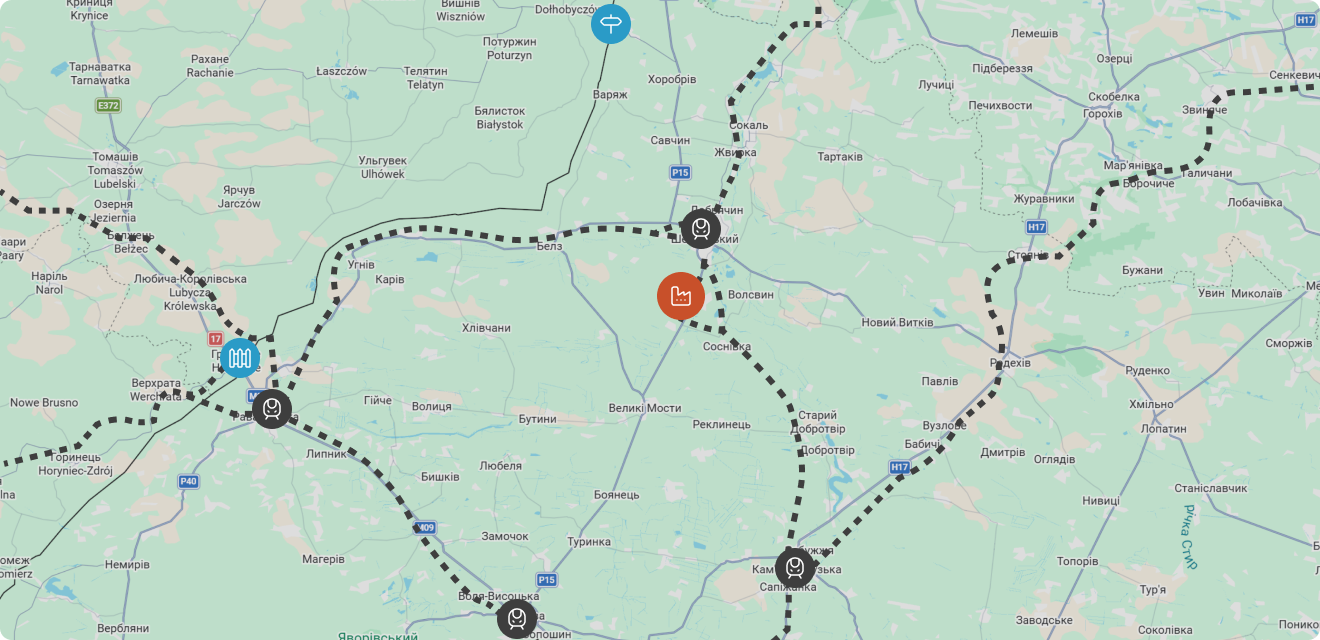
EU-border proximity35 km from the Polish border
Parameter
Typical EU Expansion Scenario
Chervonohrad Industrial Park
25-year site use cost
€42–48/m² over 25 years*
€3.45/m² over 25 years (equivalent to €115/ha/month)
Time to operations
4–8 years**
12–18 months*
Corporate income tax (nominal)
16–24% in key CEE manufacturing jurisdictions***
0% for 10 years**
Import tax burden on new equipment
—
0% import VAT and customs duty on eligible new equipment for own use
EU-border proximity
—
35 km from the Polish border
* Official comparator: ADLO tender terms for greenfield parcels in Oradea Industrial Park (Romania). ** Indicative full-cycle benchmark for new manufacturing project delivery in Europe. *** Indicative benchmark: Romania 16%, Poland 19%, Czechia 21%, Slovakia 21–24%; EU average: 21.81%. * From industrial park resident status to start of operations, including design, regulatory approvals, construction, commissioning, and utility connections. ** Subject to reinvestment of the tax-exempt amount into the development of operations within the industrial park.
War risk is part of the decision. Here is how it is addressed in practice.
For an industrial investor, the key question is whether location risk can be contained and whether practical risk-mitigation tools already exist. In western Ukraine, both conditions are already in place.
Western Ukraine should be assessed separately from frontline geographies
Lviv region is classified within Ukraine's Green Zone for investment planning according to the Investment Map of Ukraine (supported by EBA and UkraineInvest). This classification is based on the official War Risks in Ukraine Data Platform, developed with the support of global risk advisor Marsh McLennan.
For investors, this means western Ukraine can be assessed separately from frontline geographies and is highly attractive for business expansion under standard risk management protocols.
War-risk insurance mechanisms for industrial investment in Ukraine already exist
Ukraine already has working war-risk insurance pathways involving MIGA, DFC, global reinsurers, and the Ukrainian ECA. These mechanisms help eligible investment projects reduce exposure to war-related risks and make project structuring more feasible.
A strong fit for European manufacturers looking to place a new production line close to EU customers while operating from a lower-cost location near the EU border. Best suited for projects where proximity to Poland and Central Europe matters as much as cost efficiency.
A second site or satellite production base
A practical option for companies expanding capacity beyond higher-cost EU locations or establishing a second manufacturing site alongside existing EU operations. Especially relevant for Build-to-Suit projects that require layout flexibility rather than ready-made premises.
Manufacturing linked to Ukrainian and regional demand
A relevant location for producers of construction materials, industrial components, packaging, food processing, metal products, furniture, or other sectors serving both Ukraine and neighbouring EU markets. The park is designed for active manufacturing operations rather than passive land holding.
35 km to the EU border and direct rail access:what this means for logistics
Uhryniv–Dołhobyczów (UA–PL)
~35 km(~40 min)
Lviv rail hub
~70 km(~1 hour)
Warsaw
~400 km(~5 hours)
Kraków
~370 km(~4 hours)
The park plots are designed with direct access to Road P15 (Kovel–Zhovkva), providing a practical outbound route for truck logistics. A rail branch runs along the park boundary, creating an additional advantage for manufacturers that rely on freight rail.
Financial effect of resident status
How much capital can remain in your business as a resident company in the park
Manufacturing business with annual profit of €500,000
*Indicative example for illustration only
Standard Ukrainian regime
As an industrial park resident
Corporate income tax over 10 years
€900,000
€0
Import VAT and customs duty on production equipment
20% VAT + import duty
0%
Access to a 1 ha industrial plot
100% of land acquisition cost
15–23% of land value over a 30-year lease term
Up to €900,000
can remain in the business over 10 years*
*Based on the corporate tax line only · subject to reinvestment of the tax-exempt amount within the park
The 30-year lease equivalent is shown as the net present value (NPV) of annual lease payments using a 5–9% discount rate. Tax incentives are presented in accordance with Ukrainian industrial park legislation.
Trust & legal foundation
Who stands behind the project – and why that matters
The project is being developed within the broader just transition framework for the Chervonohrad coal region, supported in Ukraine by GIZ. For investors, this means the park is positioned within a recognised regional transformation agenda rather than as an isolated greenfield project.
Official legal status under Ukrainian industrial park legislation
The park is officially registered under the Law of Ukraine "On Industrial Parks". It is established for at least 30 years, and resident companies operate through a formal long-term land-use model within a legally defined industrial park framework.
Part of the region's economic transformation
The project is aligned with the economic transition of a former coal region: attracting new manufacturing, creating jobs, and building a new industrial base for long-term regional growth.
ESG & Regional Impact
Potential to create at least 990 direct jobs in the community.
Potential to support around 1,000 additional jobs in related sectors.
A new local tax base to support long-term municipal development.
Demand for reskilling the workforce of a former coal region for modern manufacturing.
A more diversified regional economy with lower dependence on the coal sector.
A foundation for ESG-compliant operations with closed-loop water systems and renewable energy readiness.
Resident roadmap
What the path to production launch looks like
1.
Initial enquiry
Short intake form, initial consultation, and a preliminary assessment of the project parameters
1–3 days
2.
Plot selection
Site review, alignment on plot size, configuration, and baseline placement terms
1–2 weeks
3.
Memorandum of intent
Signing a memorandum of intent, alignment on the core placement parameters, and launch of the contractual structuring process
1–2 weeks
4.
Plot technical documentation
Preparation of the land-management and technical documentation required for the land lease agreement
6–8 weeks
5.
Contractual entry
Legal formalisation of plot rights, signing of the land lease agreement, the economic activity agreement, and the operating agreement
2–3 weeks
6.
Delivery of the production / logistics facility
Design, construction or fit-out of the facility, together with connection to the park's engineering networks
12–18 months
Commissioning and start of operations
Q&A
Questions companies usually ask before entry
Yes. To obtain industrial park resident status, a company must be registered as a legal entity in Ukraine. For foreign investors, the standard format is a Ukrainian LLC with 100% foreign capital. Registration typically takes 2–4 weeks, and the park team can provide legal support and partner recommendations.
Yes. Ukrainian corporate law permits 100% foreign ownership of a Ukrainian LLC. There are no restrictions on foreign ownership in industrial parks. Dividend repatriation is permitted subject to applicable currency control rules.
Manufacturing industries: food and agro-processing, wood processing, furniture, paper products, non-metallic mineral products, fabricated metal products, machinery and equipment, automotive and other transport. Scientific and technical activities are also permitted. Fit with park requirements is confirmed at the application review stage.
0% corporate income tax for up to 10 years; exemption from import customs duty and import VAT on new equipment and components; and potential land payment and property tax relief subject to local council resolution.
Profit must be directed toward development of operations within the park — toward equipment, construction, modernisation or capacity expansion. Dividends are not accrued or paid during the period in which the tax benefit is applied.
New equipment and components with specified UKTZED codes imported by a park participant for its own use within the park. The equipment must be unused, and no more than 3 years may have elapsed from its manufacture date to the import date.
The standard model is a long-term lease of up to 30 years with extension options. At a lease rate of 1.5% annually of the normative monetary value, the net present value of a 30-year lease is approximately 15–23% of the plot value.
We can provide: the park's legal registration documents, the master plan and plot cadastral information, available utility connection specifications (TU), and indicative placement terms. Request the document package through the contact form.
Ready to discuss your manufacturing project in Ukraine?
Submit your enquiry — within one business day we will send you indicative placement terms and the technical parameters of available plots.
Thank you — your enquiry has been submitted. We will be in touch within one business day.
The project is being implemented with the support of Sheptytskyi City Council and within the Just Transition programme supported by the German government (GIZ).